auviaGateway
SMPP gateway

SMPP server and SMPP gateway software for A2P traffic

Give your customers an SMPP endpoint that is secured, monitored and accountable. Auvia accepts binds over plain SMPP or TLS, acknowledges a message only after it is stored, and shows every PDU when something goes wrong.
SMPP 3.4SMPP over TLSbind_transceiverPDU tracePCAP export
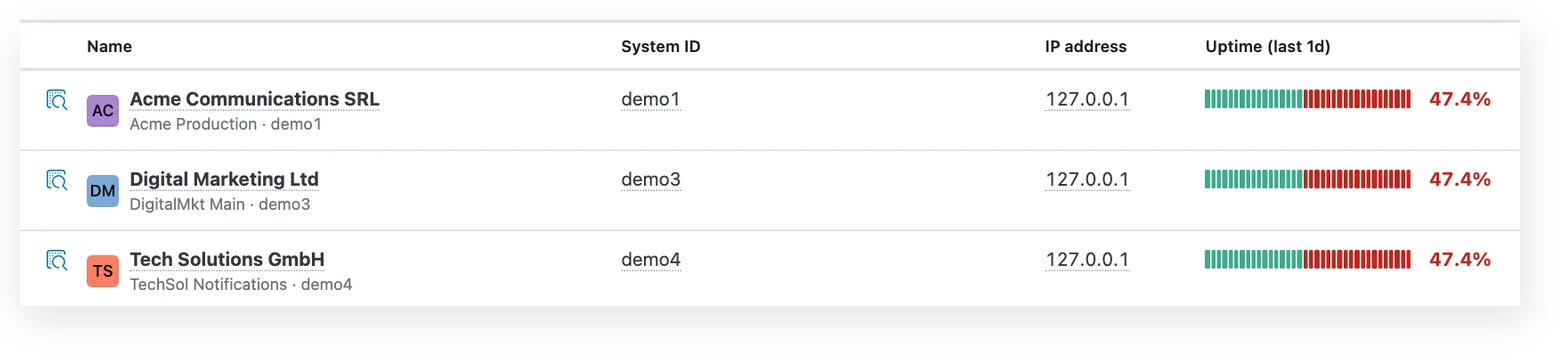
Customer Bind page with SMPP clients, system IDs, uptime history and status
Sequence

What happens between submit_sm and the receipt

One message, end to end
RequestReceipt
Message sequenceThe customer sends submit_sm. Auvia writes the message to the store and only then answers submit_sm_resp. It submits to the routed supplier with the price reserved, receives the supplier response and the delivery receipt, sends the receipt to the customer and settles the charge once. Customer (ESME)Auvia GatewayMessage storeSupplier (SMSC) 1submit_sm2write message3stored4submit_sm_resp · ESME_ROK5submit_sm (routed, price reserved)6submit_sm_resp · message_id7deliver_sm · stat:DELIVRD8deliver_sm · delivery receipt settled once · margin per segment
The acknowledgement is sent only after the message is stored. Retransmitted parts are neither sent nor billed twice.
Customer side

What your customers connect to

Binds and sessions

Transmitter, receiver and transceiver binds, session limits per credential, live session list, disconnections and uptime history.

Throughput control

TPS limits per credential and per account, priorities per account and pacing per supplier trunk, so bursts wait in the queue.

Durable acknowledgement

submit_sm_resp is sent only after the message is written to the message store. A failed store returns an error, not a lost message.

Multipart handling

Up to 20 parts, validated before acknowledgement, reassembled and priced per segment. Retransmitted parts are deduplicated.

Delivery receipts

Receipts are delivered to the customer bind with bounded retries, so a disconnected client does not pile up failures.

Security

TLS, IP allowlists per credential, automatic IP blocking after repeated failed binds, blocked-IP list in the panel.

Troubleshooting

The PDU ladder for every message

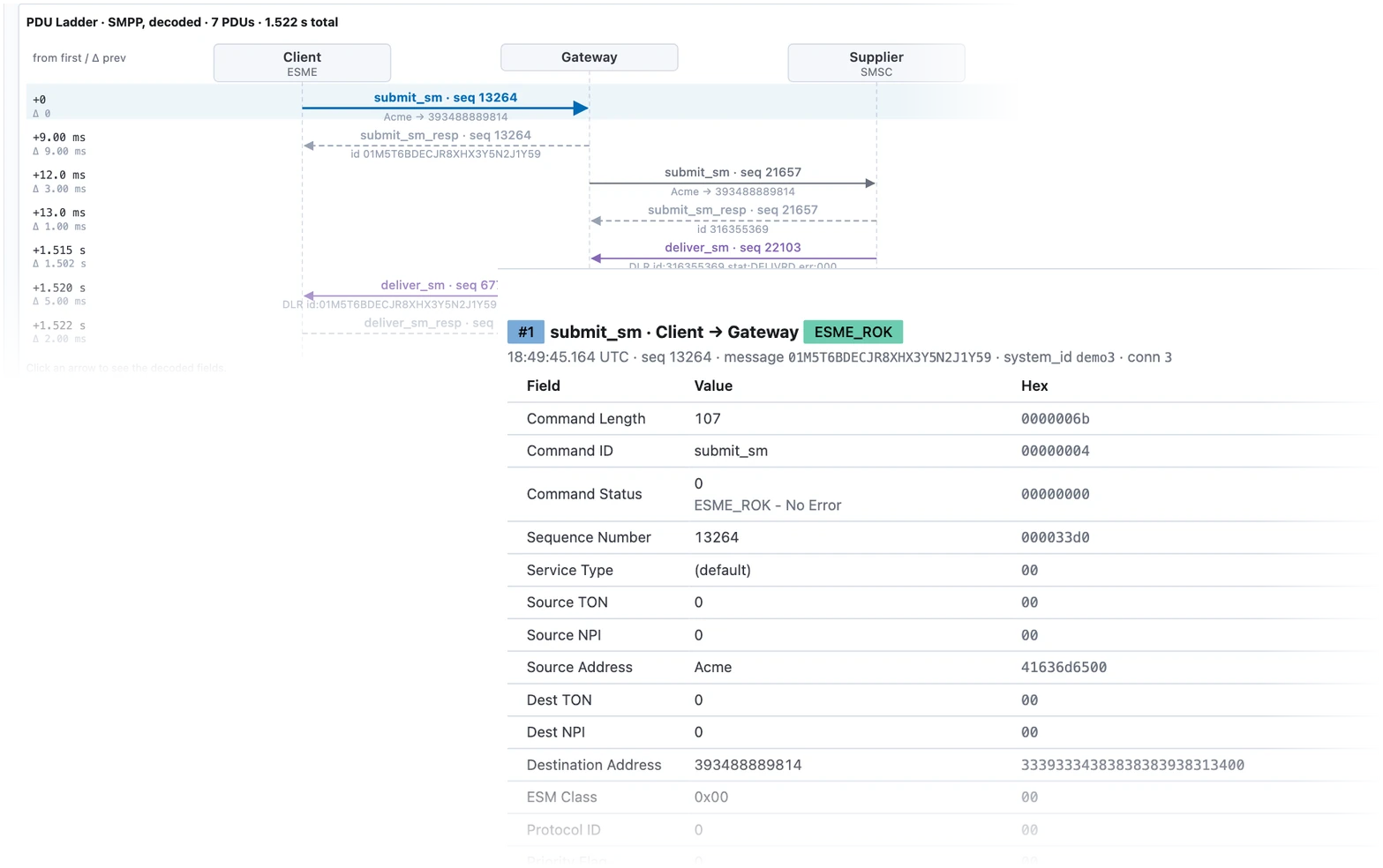
When a customer says a message never arrived, open it and read the exchange: submit_sm from the client, submit_sm to the supplier, deliver_sm back, each field decoded next to its hex.
  • Client and supplier PDUs on one timeline
  • Decoded TON/NPI, esm_class, data_coding and TLVs
  • Download a PCAP for the supplier's engineers
PDU ladder between client, gateway and supplier with decoded submit_sm fields
Supplier side

Supplier binds you can see

Connect to suppliers over SMPP 3.4 or 5.0, with TLS. Each trunk shows binds, TPS against its limit, a day of uptime, disconnections and the last error. Trunk changes apply to live sessions without a restart.

  • Per-trunk throughput limits and session counts
  • Configurable TON/NPI per trunk
  • SS7 delivery through a connected gateway trunk
Supplier binds with TPS and uptime
FAQ

Questions buyers ask

Which SMPP versions are supported?
Customers connect with SMPP 3.4, on a plain port or over TLS. Supplier connections use SMPP 3.4 or 5.0, with TLS when the supplier offers it.
How are concatenated messages handled?
Parts are validated before they are acknowledged, reassembled within a configurable window, and priced per segment. Retransmitted parts are recognised, so they are neither sent nor billed twice. Up to 20 parts per message.
Can I limit throughput per customer?
Yes: per SMPP credential and per account, shared across processes. Outbound pacing per supplier trunk queues bursts instead of rejecting them, and a 1–10 priority per account lets OTP traffic leave before bulk.
How is access protected?
SMPP over TLS, IP allowlists per SMPP credential and per API key, automatic blocking of IPs after repeated failed binds, API keys stored only as hashes, permission-based roles, and an audit log of every user action kept for 90 days.
What throughput can the platform handle?
Throughput depends on your infrastructure, connections and configuration, so we do not publish a guaranteed figure. During a technical evaluation we measure throughput and latency on your routes and hardware.
Talk to us

Let’s talk about your traffic.

Tell us your business type, the protocols towards customers and suppliers, cloud or on-premise, and the capabilities you care about. Our team comes back with a demo on the console or a technical evaluation on your scenario.